Tankless Water Heater Installation Apache Junction, AZ: What It Takes
A tankless water heater installation in the Phoenix area typically costs about $3,000 to $4,200. A good install starts with sizing by flow rate and winter temperature rise, then checks the gas line or electric panel, the venting, and the water. In our 13–16 grain hard water, isolation valves for yearly descaling are a must.
Tankless heaters heat water only when you open a tap. There is no tank to rust through and no standby heat loss. With yearly descaling, they can last 20 years or more. The catch is the setup. A tankless unit asks far more of your gas line or electrical service than a tank does, and it does not forgive poor sizing.
Apache Junction Water Heater Pros installs gas and electric tankless units and also repairs tankless heaters that were set up without the right parts. Here's how we approach a tankless water heater installation in Apache Junction, AZ.
Is a tankless water heater right for your home?
Tankless makes the most sense when you plan to stay in the home for years, have room on a wall for the unit, and either have gas service or enough electrical capacity. It makes less sense for one person in a small park model, or where the gas line and panel would both need major work.
For a full side-by-side on cost, lifespan, hard water and snowbird use, read our tank vs tankless guide for Arizona homes. In short: a tank costs far less up front, while tankless lasts longer and never runs out, as long as you don't ask it for more flow than it can heat.
Does tankless save money for snowbirds?
It can. A tank keeps reheating the same water while you're gone for the summer. A tankless unit sits idle. Outdoor units still need power for their freeze protection, though, so don't shut the breaker off before you leave for the season.
Sizing a tankless heater: flow rate and temperature rise
Tankless units are sized by gallons per minute (GPM) at a given temperature rise, not by gallons stored. Two numbers matter.
How many GPM do I need?
Add up the fixtures you might run at the same time. Rough flows:
| Fixture | Rough flow |
|---|---|
| Shower | About 1.5–2.5 GPM |
| Kitchen or bath faucet | About 1–2 GPM |
| Dishwasher | About 1–1.5 GPM |
| Washing machine (warm or hot) | About 1.5–2 GPM |
Two showers and a kitchen faucet at once can call for 5 to 6 GPM. Check the labels on your own fixtures, since newer showerheads often use less.
Why size for winter instead of summer?
The temperature rise is the gap between incoming water and the hot water you want. In Arizona summers the cold line runs warm, so the heater barely works. In December and January, incoming water is noticeably cooler and the unit has to work much harder. For example, if water comes in at 60°F and you want 120°F, that's a 60-degree rise. A unit that delivers 7 GPM in July may deliver far less in January. We size for the cold months so your winter showers stay hot.
Gas line, venting and electrical needs
Will my gas line need to be bigger?
Often, yes. A typical 40- or 50-gallon gas tank burns around 40,000 Btu per hour. Many whole-house gas tankless units are rated up to about 199,000 Btu per hour. A half-inch line sized for a tank often can't carry that much gas over a long run. An undersized line leads to weak flames, error codes and lukewarm water. We check the meter, pipe size and length before quoting, and we'll tell you if Southwest Gas or your propane supplier needs to be involved.
How does a tankless heater vent?
Your old tank's vent pipe usually can't be reused. Condensing tankless units run cool exhaust and usually vent with PVC or similar plastic pipe, often through a concentric kit that brings in fresh air and sends out exhaust through one opening. They also make acidic condensate, which needs a drain line and often a neutralizer. Non-condensing units need special stainless vent pipe. Each model's manual sets the clearances and the maximum vent length.
Can I put in an electric tankless heater?
Whole-house electric tankless heaters draw a lot of current. Many need two or three large dedicated circuits, which can add up to 100 amps or more. Many older homes and mobile homes don't have that much spare capacity, so a panel or service upgrade is common. For a single sink or a small park model, a smaller point-of-use unit may be a better fit.
Safety: Tankless units need the right gas pressure, vent and combustion air to burn cleanly. If you ever smell gas, leave the house and call 911 and Southwest Gas (or your propane supplier) from outside.
Protecting a tankless heater from hard water
Apache Junction water runs about 13–16 grains per gallon, more than twice the U.S. average. Scale builds up inside the heat exchanger, cuts flow and causes overheating codes. Our Apache Junction hard water guide explains where that water comes from.
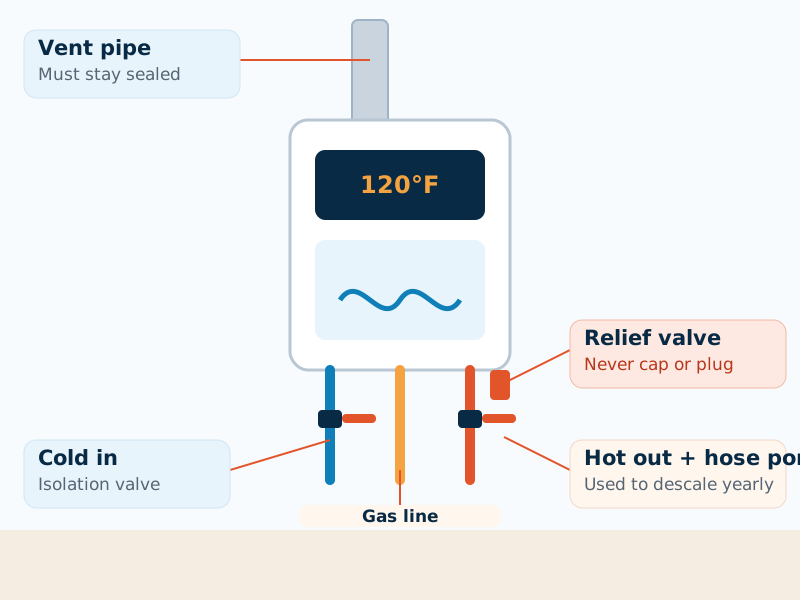
- Isolation (service) valves with hose ports on the hot and cold lines. They let you pump descaling solution through the unit without cutting pipe.
- Yearly descaling, more often if your unit shows scale warnings or you have a large household.
- Water treatment. A softener or a scale-control system on the cold line slows buildup. Many manufacturers call for treatment or more frequent descaling in water this hard, so check your model's manual.
- A clean inlet filter. Most units have a small screen on the cold inlet that traps grit.
Tip: Ask any installer whether isolation valves are included. A tankless unit installed without them is much harder and more expensive to maintain.
Permits and cost for a tankless conversion
Do I need a permit to install a tankless water heater?
Plan on it. Apache Junction's city code exempts like-for-like replacements of gas or electric water heaters of equal or lower rating. A tankless conversion isn't mentioned in those exemptions, and it usually involves a larger gas line, new venting or a new circuit. Inside city limits, permits go through Development Services at 300 E. Superstition Blvd via the MyGovernmentOnline portal. Gold Canyon and other areas outside city limits fall under Pinal County. Our water heater permit guide has the details. Rules change, so confirm for your address, and ask us about permit requirements.
How much does a tankless water heater installation cost?
Phoenix-area averages run about $3,000 to $4,200 for tankless replacement. The price rises with gas line upsizing, a long vent run, a panel upgrade, a condensate drain, or a water softener. These are area averages, not our price list. For the full tank and add-on breakdown, see our replacement cost guide.
Can a tankless heater go in a mobile home?
Sometimes. Gas water heaters in manufactured homes must be models listed for manufactured-home use, and the closet must allow proper venting and combustion air. Gas line size and outside wall access matter too. We check all of that before recommending tankless over a new tank.
How we handle a tankless water heater installation in Apache Junction, AZ
- Look at use and space. We count fixtures, check where the unit can mount, and note indoor or outdoor placement.
- Check supply. We measure the gas line run and meter, or the electric panel, and look at your water hardness.
- Size for winter. We choose a unit by GPM at a cold-month temperature rise, not a summer one.
- Install with service parts. Isolation valves, a pressure relief valve, proper venting, a condensate drain where needed, and freeze protection for outdoor units.
- Test and explain. We fire it, check flow and temperature at several taps, set it around 120°F, and show you how descaling works.
Still deciding whether to replace your old tank like-for-like instead? Our water heater replacement page covers gas, electric and mobile-home tanks. For leaks on your current heater, start with water heater leak repair in Apache Junction.
Tankless Water Heater Installation Apache Junction, AZ: FAQs
How long does a tankless installation take?
A swap of one tankless unit for another is often done in part of a day. A first-time conversion from a tank takes longer, especially if the gas line, vent or electrical service has to change. We'll give you a realistic time frame after we see the site.
Can a tankless heater be installed outside in Apache Junction?
Yes, many models are made for outdoor mounting, which saves space and venting. They need power for built-in freeze protection, since winter lows here have dropped into the high teens. Exposed pipes and valves should be insulated too.
Will one tankless unit run two showers at once?
A properly sized whole-house unit usually can, if it's sized for winter water and the gas line can feed it. A small or undersized unit will drop temperature when a second fixture opens. Tell us how your household uses hot water so we size it right.
Do I need a water softener with a tankless heater?
It isn't always required, but in water at 13–16 grains per gallon it helps a lot. Without treatment, plan on descaling at least once a year. Check your model's manual, since some manufacturers have specific rules about hard water.
What temperature should a tankless heater be set to?
Around 120°F suits most homes, which is what the U.S. Department of Energy suggests. Higher settings make scale build faster in hard water and raise the risk of scalding, so only go higher if you have a specific need.
Can my old tank's water lines be reused?
The supply lines can often be connected, but the layout usually changes, since the tankless unit mounts on a wall. We add isolation valves and a pressure relief valve, and we cap or remove the old vent if it's no longer used.