Do You Need a Water Heater Expansion Tank?
You need a water heater expansion tank if your home is a closed system, meaning a pressure-reducing valve, check valve or backflow device stops heated water from pushing back into the city line. The tank absorbs that extra water. Installing one means sizing it, setting its air charge to your house pressure and mounting it on the cold line.
Many homes around Apache Junction have no expansion tank at all, or have one that quietly failed years ago. The most common sign is a relief valve that lets out water now and then, often in the afternoon or after the heater runs. If you're still working out why your T&P valve drips, our relief valve leaking guide walks through the two usual causes: a worn valve or thermal expansion.
Thermal Expansion, in Plain Terms
Water gets bigger when it's heated. Not by much, but a 50-gallon tank of cold water heated to about 120°F grows by roughly half a gallon, more if it started colder or is set hotter. That extra water has to go somewhere.
In an open system, it simply pushes back into the street main. Nobody notices. In a closed system, it can't. Water doesn't squeeze, so the pressure in every pipe in the house jumps. Each time the heater runs, the pressure climbs until something gives. Usually that's the T&P valve, which lets a little water out. Sometimes it's a toilet fill valve, a faucet cartridge or a flex connector.
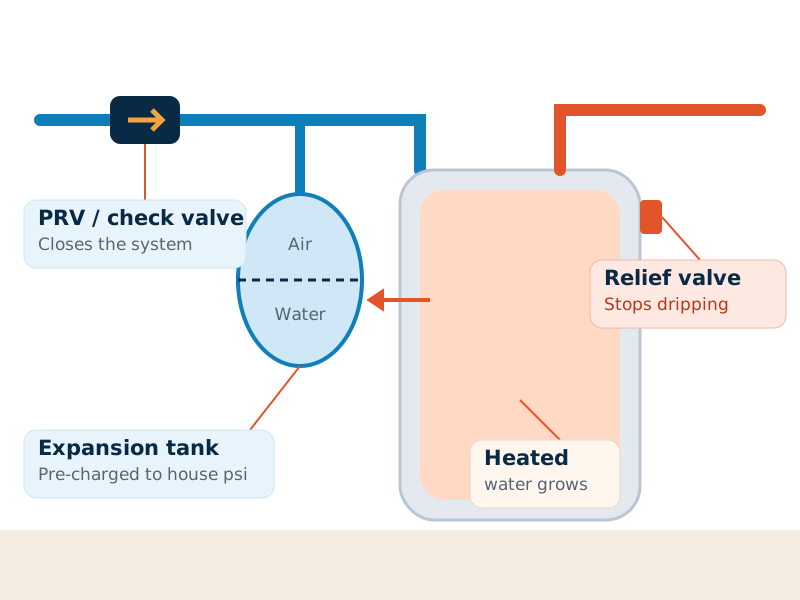
What makes a plumbing system "closed"?
Any one-way device between your home and the street main. The common ones are a pressure-reducing valve (PRV) on the main line, a check valve at or near the meter, and backflow preventers. Some newer and smart meters include a check valve too. If your water provider has swapped your meter, your system may have become closed without anyone telling you.
Signs You Need One, or Yours Has Failed
- The relief valve lets out water now and then, not a constant drip. It's worse on hot afternoons or after showers and laundry.
- Pressure spikes on a hose-bib gauge, well above your normal house pressure, while the heater is running.
- A toilet hisses or refills for a moment when no one has flushed it, as the fill valve reacts to a pressure jump.
- Faucets or fittings drip and the drips come back soon after repairs.
- Flex connectors on top of the heater keep failing. Our water heater leaking from pipes guide covers those leaks.
How do I check if my expansion tank is still working?
With the water heater cold, tap the expansion tank. The top half should sound hollow. If it sounds solid all the way up, it's full of water. You can also press the small air valve on the end for a split second. Air is good. Water means the inner bladder has failed, and the tank needs replacing. A failed tank does nothing, even though it's still hanging there.
Sizing and Pre-Charge: Where Most Installs Go Wrong
An expansion tank only works if it's the right size and its air charge matches your water pressure. A tank that's too small fills up and stops helping. A tank with the wrong air charge either fills with water right away or barely takes any in.
What size expansion tank do I need?
It depends on two numbers: the size of your water heater and your house water pressure. On a typical 40- or 50-gallon heater with normal house pressure, a small 2-gallon tank is common. A bigger heater, a higher house pressure or a higher temperature setting can call for a larger tank. We size from the expansion tank maker's chart instead of guessing.
Why does the pre-charge matter?
Expansion tanks come from the factory with an air charge, often around 40 psi. Your house may run at 55, 65 or more. Before the tank goes on the line, we measure your static water pressure and set the tank's air charge to match it with a tire pump and gauge. If you skip this step, the tank can fill with water as soon as it's connected and leave no room for expansion.
| What we measure | Why it matters |
|---|---|
| Static house pressure | Sets the tank's air charge and tells us if the PRV is working |
| Water heater size | More gallons heated means more expansion to absorb |
| Temperature setting | Hotter water expands more |
| Pressure during a heating cycle | Shows how bad the spikes are before and after the install |
House Pressure and the 80 psi Guideline
Plumbing codes generally call for a pressure-reducing valve when incoming water pressure is over 80 psi. Many homes have one. PRVs also wear out, and when they do, house pressure creeps up toward street pressure.
An expansion tank handles the spikes from heating. It doesn't fix high static pressure. If your pressure sits above 80 psi with the heater idle, the PRV needs attention first, and the expansion tank should be set to the corrected pressure. We check both on every visit so you don't end up with a new tank sized for the wrong number.
Tip: A hose-bib pressure gauge with a red "max" needle is one of the most useful cheap tools a homeowner can own. Screw it onto an outdoor faucet, leave it overnight, and the max needle tells you how high the pressure got.
How We Install an Expansion Tank
- Measure first. We check static house pressure and watch it through a heating cycle to confirm thermal expansion is the problem.
- Size and set the tank. We pick the tank from the maker's chart and set its air charge to your house pressure before it's connected.
- Shut off the water and relieve pressure. Cold-water valve closed, a hot tap opened, heat off if needed.
- Install on the cold line between the shut-off valve and the heater, using a tee and fittings rated for potable water.
- Support the tank. A 2-gallon tank full of water weighs well over 15 pounds. We use a bracket or strap so it isn't hanging from the pipe and stressing the fittings.
- Refill and test. We open the water back up, check for leaks, turn the heat on, and watch the pressure through a heating cycle to confirm the spikes are gone.
Does a T&P valve need replacing at the same time?
Sometimes. If the relief valve has been opening for months, scale and wear may keep it dripping even after the pressure is fixed. We test it after the expansion tank is in. If it still drips, our relief valve replacement page explains how we match and swap it.
Lifespan, Care and Replacement
Expansion tanks wear out. The rubber bladder inside eventually leaks, and the air side slowly fills with water. Once that happens, the tank stops protecting your heater. Many tanks fail well before the water heater does, and since a failed one looks the same from the outside, it's easy to miss.
- Tap test it once a year with the heater cold.
- Check for rust or drips at the bottom fitting and around the seam.
- Watch the relief valve. If it starts letting out water again, check the expansion tank first.
- Replace the expansion tank when you replace the water heater, unless it's fairly new and tests good.
What affects the cost of an expansion tank install?
The tank size, how easy the cold line is to reach, whether new valves or fittings are needed, whether the PRV also needs replacing, and the bracket or strap to hold it. Tight closets and old galvanized piping add time. We explain the price before any work starts.
Planning a new heater? An expansion tank is part of a proper install. See our water heater replacement page. For other valve and pressure problems, our water heater repair service page covers the full list, and our water heater leak repair in Apache Junction page is the place to start if water is already on the floor. Call (480) 555-0147 any time.
Expansion Tank Installation FAQs
Where should an expansion tank be installed?
On the cold-water line feeding the water heater, between the cold shut-off valve and the heater. It can hang vertically or sit at an angle, as long as it's supported by a bracket or strap and not just the pipe. Follow the tank maker's instructions for its position.
Can an expansion tank go on the hot side?
It's generally installed on the cold side. Cooler water is easier on the rubber bladder and it's where the maker's instructions usually put it. Some tanks are rated for either side, but the cold line is the standard and the safer choice.
Do I need an expansion tank if I don't have a PRV?
Maybe. A check valve at the meter or a backflow device can close your system even without a PRV. Some meters include a check valve too. A pressure gauge on a hose bib during a heating cycle tells you. If pressure spikes when the heater runs, the system is closed.
Does a tankless water heater need an expansion tank?
Usually not for thermal expansion, since tankless units hold very little water. But closed systems can still have pressure problems, and some local requirements or makers address it. We look at the setup on a case-by-case basis rather than adding parts that aren't needed.
How long does an expansion tank last?
It varies with water quality, pressure and temperature. In hard water and summer heat they often don't outlast the heater. Rather than going by age, tap test it once a year and check the air valve. A tank that sounds full or spits water needs replacing.
Can I add air to my expansion tank instead of replacing it?
If the bladder is intact, the air charge can be reset, but the water has to be off and the pressure relieved to set it correctly. If water comes out of the air valve, the bladder is torn and adding air won't last. Replacement is the fix.