Why Are the Pipes on My Water Heater Leaking?
Pipes around a water heater usually leak at a joint: a worn supply line, a soldered copper fitting, a PEX crimp or expansion fitting, or a valve. Hard water, garage heat and high water pressure speed this up. Pipe leaks are repairs, not a reason to replace the heater. If pressure is over 80 psi, fix that too.
This page is about the plumbing that runs to and from the heater: the cold line coming in, the hot line going out, valves along those lines, and anything else tied into them, like an expansion tank or a recirculation loop. If the water is coming from the connections right on the lid of the tank, our page on a water heater leaking from the top covers the nipples, anode port and vent.
Which Pipe Is Leaking? Know What You're Looking At
Homes in Apache Junction were built across many decades, and the pipes show it. Here's what you're likely to see near the heater.
Flexible supply lines
Short corrugated metal or braided hoses that connect the house pipes to the heater. Rubber washers inside each nut wear out with heat and age.
Copper with soldered joints
Common in site-built homes. "Sweat" joints can weep where solder didn't flow fully, and hard water can wear pinholes in the pipe near fittings and elbows.
PEX (red, blue or white plastic)
Joined with crimp rings, clamp rings or expansion fittings. Leaks usually come from a ring that wasn't fully crimped, or plastic damaged by heat or sunlight.
Older gray plastic pipe
Many homes and mobile homes built from the late 1970s to the mid-1990s used gray polybutylene pipe. Its fittings are known for failing with age. Leaks here are a sign to plan for repiping that section.
How do I know if it's a pipe or the heater?
Follow the water upward. If the highest wet spot is on a pipe, valve or fitting a few inches or more away from the tank, it's a pipe leak. If water appears on the tank body with dry pipes above it, check our water heater leak finder for the other leak spots.
What Makes Water Heater Pipes Leak?
Hard water and corrosion
Apache Junction tap water runs about 13–16 grains per gallon of hardness, more than double the US average. Minerals build up inside fittings and valves, and green or white crust on copper joints is a sign water has been seeping for a while. Where copper meets steel without a proper dielectric fitting, galvanic corrosion eats away at the joint too. More on local water on our hard water page.
Heat in garages, attics and outside closets
July highs here average about 105°F, and a closed garage or an outdoor closet in the sun runs hotter. Heat hardens the rubber washers in supply lines and valve seals. PEX can handle hot water, but it needs to be kept a safe distance from a gas heater's flue, as the manufacturer's instructions call for. It also shouldn't sit in direct sunlight, because UV light breaks it down. If your PEX near the heater is faded, brittle or touching the vent, have it looked at.
Fittings that were never quite right
A crimp ring that's slightly off, a gap in the solder, or too little thread sealant can hold for months, until heat and pressure swings work it loose.
Valves on the lines
Old gate valves leak at the stem when turned and often won't close all the way. Ball valves can weep at the handle as their seals age. A valve that won't fully shut off is worth replacing before you need it in an emergency.
Is High Water Pressure Making Things Worse?
High pressure is one of the most overlooked causes of pipe and fitting leaks. Every joint in the house carries that pressure all day. Pressure above 80 psi is commonly treated as too high for home plumbing, and it wears out supply lines, valves and fittings faster.
How do I check my water pressure?
Buy an inexpensive pressure gauge that screws onto a hose bib (an outdoor faucet). Screw it on with all the water in the house off, open the faucet and read the needle. Check at different times, like early morning and late evening, because pressure can change through the day.
What is a pressure-reducing valve?
A pressure-reducing valve, or PRV, sits on the main line where water enters the house. It lowers street pressure to a safer level. PRVs wear out over time, and when they fail, pressure can creep up without warning. If your reading is high, the PRV may need adjusting or replacing, or your home may need one added.
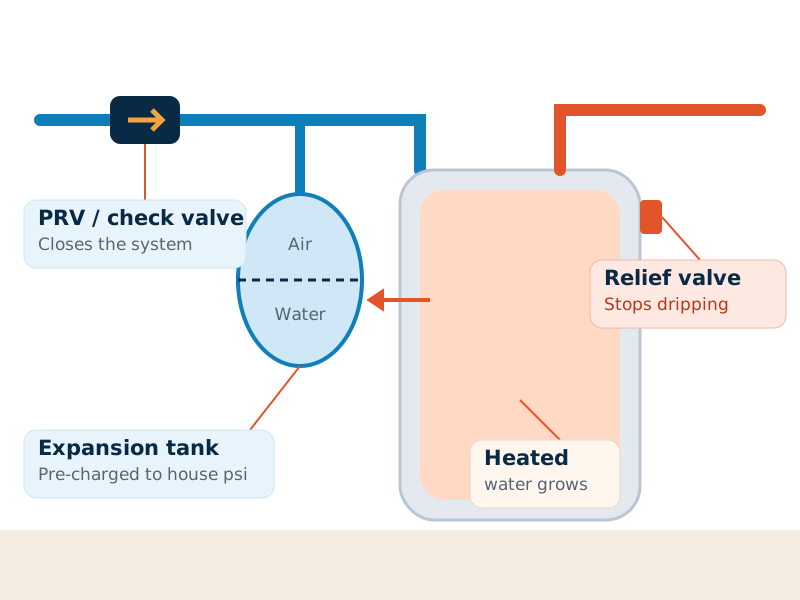
Does the expansion tank connection leak too?
It can. The expansion tank threads onto the cold line near the heater, and that joint can drip like any other. A PRV or check valve also turns your plumbing into a closed system, so heated water has nowhere to go and pressure spikes each time the heater runs. A working expansion tank absorbs that. If yours is leaking, waterlogged or missing, see our page on expansion tank installation.
Recirculation Lines and Other Extra Plumbing
Some homes have a hot water recirculation system, with a small pump and a return line that ties into the cold side or the drain valve of the heater. That adds more joints, a check valve and a pump with its own seals, and any of them can drip. A recirculation leak often shows up near the bottom of the heater, which can make it look like a drain valve or tank problem.
Also check lines passing above the heater, like an AC condensate line. A drip from above can fool you.
What to Do About a Leaking Water Heater Pipe
- Slow the water. Close the cold shutoff above the heater. If the leak is on the cold line before that valve, you'll need to shut off the main to the house. Our shutoff guide shows where to find each valve.
- Turn off the heat. Breaker off for electric, gas knob to "Pilot" for gas, so the heater doesn't run while the water is off.
- Find the highest wet spot. Dry the pipes and wrap each joint with a paper towel. Check it after 15 to 30 minutes.
- Check your pressure. Once the leak is under control, take a hose bib reading. If it's high, mention it when you call.
- Protect what's nearby. Pull boxes away, put down towels, and check the drywall behind a garage heater or the floor of a mobile-home closet.
Tip: If you have to close the main to stop the leak, leave the heater off too. Running a heater with the water supply shut off is hard on the tank and elements.
Can I fix a leaking water heater pipe myself?
Replacing a flex supply line with the water off is a job many handy homeowners do. Soldering copper near a gas heater, cutting in PEX fittings or replacing old gray pipe takes the right tools and some care. If the pipe runs inside a wall or under a mobile home, call us.
When a Pipe Leak Needs More Than a Patch
- Several fittings near the heater are crusty or green
- Pressure reads over 80 psi and the PRV is old or missing
- You have gray polybutylene pipe and this isn't the first leak
- Leaks keep coming back after each repair
- The pipes are fine, but the heater is old and the shutoff valve is seized
If the cause is pressure or old piping, fixing one drip just moves the leak. We'll look at the whole setup and tell you what's worth doing now. Apache Junction Water Heater Pros is open 24/7. See how we approach water heater leak repair in Apache Junction, or call (480) 555-0147.
Water Heater Pipe Leak FAQs
Why is the cold water pipe on my water heater wet?
Sometimes it's a slow leak at a fitting or the shutoff valve. In humid monsoon weather, a cold pipe can also sweat on the outside. Wipe it dry and wrap it with a paper towel. A wet spot at one joint is a leak. Even dampness along the whole pipe is usually sweating.
What water pressure is too high for a water heater?
Pressure over 80 psi is commonly treated as too high for home plumbing. It strains supply lines, valves and the heater's relief valve. Check it with a hose bib gauge. If it's high, a pressure-reducing valve on the main usually needs adjusting, replacing or adding.
How often should water heater supply lines be replaced?
There's no set schedule, but it makes sense to replace them whenever the heater is replaced and any time you see rust, bulges, kinks or crusty nuts. In hot garages and outside closets, the rubber washers wear sooner. Never reuse old lines on a new heater.
Can a leaking PEX fitting be tightened?
No. Crimp, clamp and expansion fittings can't be tightened once installed. A leaking PEX joint has to be cut out and redone with a new fitting. Check the pipe near the fitting too, since heat damage or a nick can be the real problem.
Will my water heater still work if a pipe is leaking?
It may keep heating, but leaving it running means more water lost and more damage. Close the cold shutoff and turn the heater off until the pipe is fixed. If you must close the main, keep the heater off until the water is back on.
Why do the pipes near my water heater keep leaking?
Repeat leaks usually point to a bigger cause: high water pressure, a failing PRV, a missing or dead expansion tank, aging gray plastic pipe, or very hard water wearing joints. Fixing each drip without fixing the cause just moves the problem to the next fitting.