What a Water Heater Flush Does for Your Tank
A water heater flush drains the tank and washes out the hard-water sediment that settles on the bottom. In Apache Junction, where tap water runs about 13–16 grains per gallon, once a year is a good schedule. Our flush visit also checks the drain valve, anode rod, relief valve and water pressure, so small problems get caught early.
Every time your heater warms a tank of water, some of the calcium and magnesium in it drops out as solid grit. That grit sinks and piles up on the bottom of the tank. On a gas heater it sits between the burner and the water. On an electric heater it buries the lower element. Either way, the heater works harder, makes noise and wears out sooner.
Flushing doesn't make hard water soft, and it can't undo years of hardened scale. What it does is clear out the loose layer before it turns into a crust. It's one of the cheapest things you can do for a tank that cost you over a thousand dollars to install.
What Our Water Heater Flush Apache Junction, AZ Visit Includes
A flush is more than opening a valve and walking away. Here's what we do on a standard tank visit, in the order we do it.
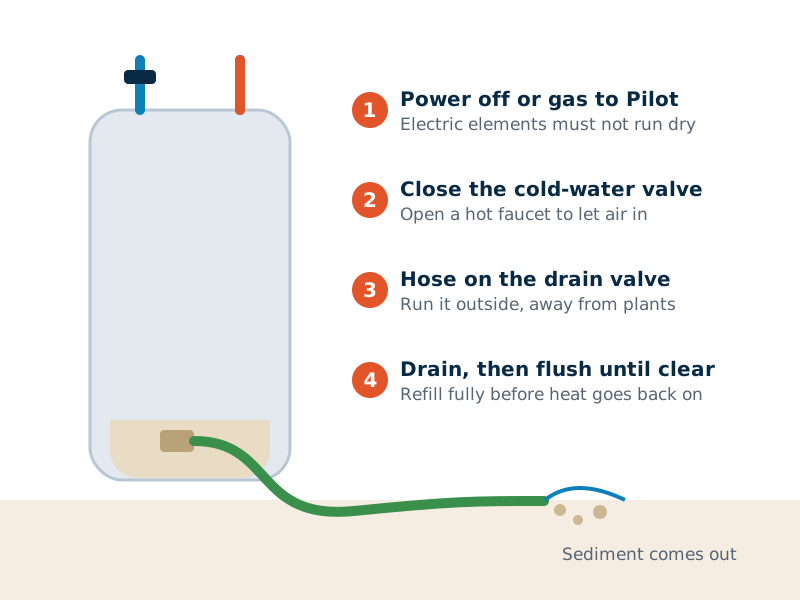
- Check the drain valve first. Before we open anything, we look at the valve's type and condition. An old plastic valve on a tank that has never been drained gets a talk before a flush (more on that below).
- Shut down safely. We turn the gas control to Pilot or Off, or switch off the breaker, then close the cold-water supply. Electric elements must never run in an empty tank, so the power stays off until the tank is full again.
- Drain and flush until clear. A hose runs from the drain valve to a safe spot. We open the cold supply in short bursts to stir the sediment and keep going until the water comes out clear, not just lighter.
- Inspect the anode rod. Where the hex head can be reached, we pull the rod and show you how much is left. A rod worn down to its core wire means the tank is losing its protection.
- Test the T&P relief valve. We lift the lever briefly to make sure it opens and reseats. A valve that won't reseat or keeps dripping needs replacing. It must never be capped or plugged.
- Check the pan, pressure and expansion tank. We look for a drain pan and a working drain line, measure house water pressure, and check the expansion tank if you have one.
- Refill, relight and set the temperature. We refill with a hot faucet open to push the air out, restore gas or power, check for drips and set the dial to about 120°F, the DOE's suggestion for most homes, unless you need it higher.
You get a plain report at the end: how much sediment came out, what the anode looks like, and anything that needs attention now or later. If we find a part that's close to failing, we tell you the price before doing anything about it.
How Often to Flush in Water This Hard
Many manufacturers suggest draining a tank yearly, and Apache Junction is exactly the kind of place they have in mind. At about 13–16 grains per gallon, local water is more than twice as hard as the US average of about 6. You can read where that comes from in our guide to hard water in Apache Junction.
Is my water heater overdue for a flush?
Probably, if any of these sound familiar. Rumbling or popping when the heater runs is the clearest sign, because that's water trapped under sediment boiling in bursts. Hot water that runs out sooner than it used to is another. So is a gritty feel in faucet aerators or a lot of white flakes in the hot water.
- Yearly: most tanks in Apache Junction, Gold Canyon and East Mesa homes
- Every 6 to 12 months: large families, homes with heavy hot water use, or heaters set above 120°F
- Before and after a long trip: winter visitors whose tank sits idle for months
- Less often: homes with a working water softener, though the anode still needs checking
Does flushing help a heater in a hot garage or outside closet?
It helps in the same way, but the location adds wear of its own. A heater in a garage that hits well over 100°F in July, or in a mobile home's outside closet, sees more stress on washers, connectors and gas parts. The flush visit is a good time to look at those too.
When We Don't Recommend Flushing
This is the part most flush ads skip. A flush is usually a good idea, but not always.
Should you flush a very old tank that has never been flushed?
Sometimes it's better not to. On a tank that's 10 or more years old and has never been drained, sediment may be packed hard around the drain valve. Opening an old plastic valve can stir up grit that keeps it from closing fully again, and then you have a drip that wasn't there before. In rare cases, loosening that crust can also expose a weak spot in a tank bottom that was already thin.
That doesn't mean the tank is about to fail. It means a flush may not be worth the risk on that heater. On those tanks we look at the age, the anode rod and the water around the base first, and talk it through with you. Sometimes the honest answer is to leave it alone and start planning for a replacement. We weigh the tank's age and condition against the cost of a new heater, and you make the call.
Tip: If we do flush an older tank with a plastic drain valve, swapping it for a full-port brass valve at the same visit costs much less than coming back later for a drip. See our drain valve leak page if yours is already dripping.
When is a flush the wrong fix?
If water is coming from the tank body, the bottom seam or wet insulation behind the access panel, the tank has rusted through. A flush won't help. Call us about water heater leak repair in Apache Junction instead. If you have no hot water at all, the cause is almost always a part, not sediment, and that falls under our full water heater repair service.
Tankless Descaling vs. Tank Flushing
Both jobs fight the same hard water, but they work differently.
Tank flush
Water drains out through the drain valve and carries loose sediment with it. The goal is to remove grit that has settled on the bottom. No chemicals are needed.
Tankless descaling
A small pump circulates vinegar or a descaling solution through the heat exchanger using the isolation valves, usually for about an hour. It dissolves scale stuck to the inside of the exchanger.
Tankless units are more sensitive to scale than tanks. Buildup in the heat exchanger can bring on error codes, temperature swings and short bursts of cold water. In water this hard, yearly descaling is part of what lets a tankless heater reach 20 years or more. If your tankless unit is already showing codes, see our tankless repair service.
What a Water Heater Flush Costs
Across the Phoenix area, a professional tank flush averages about $75–$150. Where a job lands in that range depends on how much sediment comes out, how easy the heater is to reach and what the visit includes.
| Item | What affects the price |
|---|---|
| Standard tank flush | Area average about $75–$150; heavy sediment takes longer |
| Anode rod replacement | Rod type, rod length and how tight the hex head is |
| Drain valve upgrade | Plastic to brass swap, best done while the tank is empty |
| Tankless descaling | Unit size and whether isolation valves are already installed |
We tell you the price before we start. If the anode is worn out, our anode rod replacement page explains the options. If your relief valve drips after showers, an expansion tank may be the fix.
Can I flush my water heater myself?
Yes, if the tank is in good shape and you can reach the valves. Our step-by-step flushing guide covers the tools, the safety steps and what to do if the drain valve won't close. Call us when the valve is old plastic, the tank is very old, or you'd rather someone check the anode and relief valve while it's drained.
Booking a Water Heater Flush in Apache Junction, AZ
We're based at 279 N Ironwood Dr #106 and do flush and maintenance visits across both city ZIP codes, from older homes and mobile-home parks near the Apache Trail to newer homes toward the Superstition Mountains. Gold Canyon and East Mesa are close by too.
Fall and early winter are good times to book, before seasonal residents come back and before the coldest mornings ask more of your heater. We're open 24/7, so call (480) 555-0147 when it suits you. A water heater flush in Apache Junction, AZ is quick, and we'll leave the tank full, hot and checked.
Water Heater Flush Apache Junction, AZ: FAQs
How long does a professional water heater flush take?
Most tank flushes take about an hour, including the anode and relief valve checks. A tank with a lot of sediment, a slow drain valve or a hard-to-reach closet can take longer. Refilling and reheating the water afterward takes extra time, so plan on hot water returning later in the day.
Will flushing stop my water heater from rumbling?
Often it does, because rumbling comes from water trapped under loose sediment. If the sediment has hardened into a crust, a flush may only quiet it partway. Loud rumbling on an older tank that doesn't improve after a flush is a sign the tank is near the end of its life.
Can flushing cause my water heater to leak?
It can, mostly on older tanks with plastic drain valves. Grit can keep the valve from sealing once it's opened. That's why we check the valve first and suggest a brass replacement when needed. A flush doesn't create tank leaks, but it can reveal a bottom that was already weak.
Do I need to be home during a flush?
Someone needs to let us in and show us the heater, and it helps if you're there at the end so we can show you the anode rod and talk about anything we found. Hot water will be off for part of the visit.
Is a water softener a replacement for flushing?
Not fully. A softener cuts down on new sediment a lot, but some still collects, and softened water can wear anode rods faster. Homes with softeners can usually flush less often, but they should still get the anode checked every few years.
Do mobile home water heaters need flushing too?
Yes. Smaller mobile home and park model tanks hold less water, so the same sediment fills a bigger share of the tank. The flush is the same idea, though outside-access closets can make the hose setup a little different.