Why Is My Water Heater Leaking From the Top?
A water heater leaking from the top is usually leaking at a connection: the cold or hot nipple, a flex connector, the shutoff valve, the T&P valve threads or the anode rod port. On gas units, water can also drip down the flue. These are repairs. The tank only needs replacing if water is seeping from the tank itself.
The top of a tank heater is busy. Water lines, a shutoff, a relief valve, an anode rod and, on gas models, a vent all meet in a small space. Every one of those parts can be replaced without touching the tank. The catch is that top water rarely stays on top. It slides under the jacket and puddles at the base, so a top leak can look like a dead tank.
The Six Places a Top Leak Starts
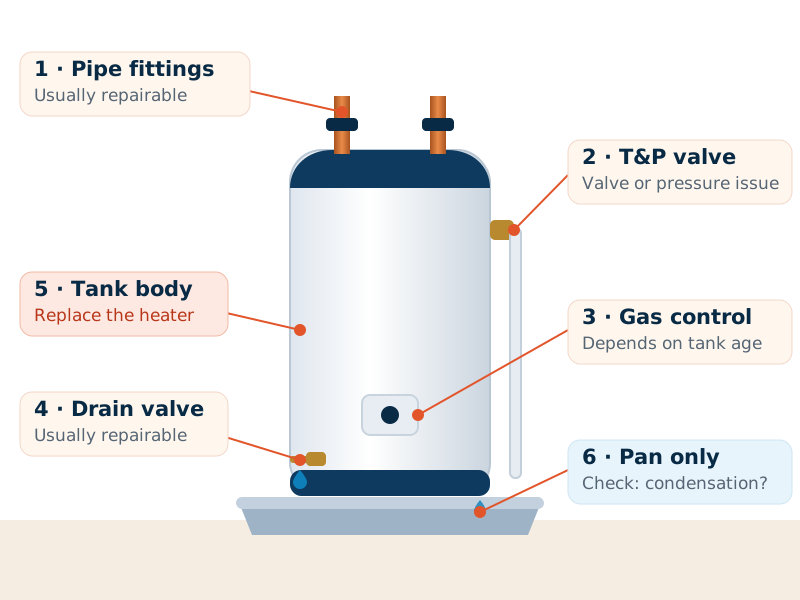
| Wet spot | Usual cause | Fix |
|---|---|---|
| Where the cold or hot pipe enters the tank | Rusted nipple from galvanic corrosion | Replace the nipple (and connector) |
| Along a flexible water line | Worn washer, kinked or corroded connector | Replace the connector |
| Around the handle of the cold shutoff | Loose or worn packing nut | Snug the packing nut or replace the valve |
| Threads under the T&P relief valve | Failed thread seal or corrosion at the port | Reseal or replace the valve |
| Hex plug on top of the tank | Anode rod threads not sealing | Reseal or replace the anode rod |
| Drips around the vent on a gas unit | Flue condensation or rain coming down the vent | Depends on the source |
Nipples and Flex Connectors
The cold inlet and hot outlet thread into the tank through short pipes called nipples. Many are "dielectric" nipples, made to keep the steel tank and copper house pipes from touching. When two different metals touch in water, the weaker one corrodes. That's galvanic corrosion. Over time the lining in the nipple wears or the threads rust, and you get a slow weep with a crust of white, green or rusty buildup around it.
Above the nipples, most heaters in Apache Junction connect with flexible water lines, either corrugated metal or braided hose. Each end has a rubber washer. Apache Junction garages run well over 100°F in July, and the washers harden. Our 13–16 grain water scales the threads too.
Can I just tighten a leaking water heater connection?
Sometimes, for a while. A quarter turn on a loose flex nut can stop a fresh drip. Crust or rust means the part is corroding and tightening won't hold. Replace the connector, and the nipple if it's rusted.
Shutoff Valve, Relief Valve and Anode Port
Why is water dripping from the shutoff valve handle?
Many valves have a packing nut under the handle. When it loosens or wears, water seeps around the stem, often right after the valve is turned. A gentle snug on the packing nut, about an eighth of a turn, often stops it. If the valve is old, stiff or won't fully shut off, it's time for a new quarter-turn valve.
Is water around the relief valve the same as a relief valve leak?
Not quite. Water coming out of the T&P discharge pipe is the valve opening, which is its own topic on our relief valve leaking page. Water around the threads, where the valve screws into the tank, is a sealing problem. A fresh seal or a new valve usually fixes it. Heavy rust at that port on an older tank is a warning sign, though, because corrosion there can reach the tank wall. If the valve itself has to come out, see our page on relief valve replacement.
What is the hex plug on top of my water heater?
That's usually the anode rod. It threads into the top of the tank and slowly wears away so the tank doesn't rust. If water seeps around the hex head, the threads aren't sealing. In hard water the rod also wears fast, and a stuck, corroded rod can be hard to remove. We cover checking and changing it on our anode rod replacement page.
Gas Heaters: Water From the Vent or Flue
On a gas tank, a metal pipe rises from the center of the lid. That's the flue and vent. Burning gas makes water vapor. When the tank is full of cold water, some of that vapor turns back into water on the cool flue walls and drips down onto the burner. You may hear a hiss or sizzle. This is condensation, and it usually stops once the tank warms up. Our condensation vs. leak guide shows how to tell the two apart.
Can rain get into my water heater through the vent?
Yes. If a vent cap is missing or bent, or the roof flashing around the vent is cracked, monsoon rain can run straight down the pipe. It shows up at the draft hood on top of the tank or on the burner below. The clue is timing: water after a storm, dry the rest of the week. That's a vent or roof repair, not a water heater leak.
Safety: Rust, soot or scorch marks around the draft hood can mean the heater isn't venting properly. That can let exhaust into your home. Turn the gas control to "Off" and call us. If you smell gas, leave the house and call 911 and Southwest Gas (or your propane supplier) from outside.
Electric Heaters: Is a Wet Upper Panel a Top Leak?
Electric elements sit on the side behind small panels, not on top. But the upper panel is close enough to the top to cause confusion.
What does water behind the upper element panel mean?
Turn off the breaker, then remove the panel. Water running down from the fittings above is a top leak. A weeping element gasket means a new gasket or element. Soaked insulation with a dry element can mean the tank is leaking, which means replacement.
How to Find a Top Leak in 15 Minutes
You need a flashlight, a step stool and dry paper towels.
- Make it safe. If water is spraying, close the cold shutoff and turn off the breaker or set the gas to "Pilot." Our guide on shutting off a water heater shows where everything is.
- Dry the whole top. Wipe the pipes, valves, lid and the area around the vent.
- Wrap each joint. Fold a paper towel around the cold nipple, hot nipple, both ends of each flex line, the shutoff stem and the T&P threads.
- Check the highest wet towel. Wait 15 to 30 minutes. Water runs down, so the highest wet spot is the source.
- Note the pattern. Constant drip means a fitting. Water only while the burner runs on a cold tank points to condensation. Water only after storms points to the vent.
What You Can Safely Check vs. When to Call
Fine to try yourself
Drying and wrapping joints to find the leak. Snugging a loose flex nut a quarter turn. Snugging a shutoff packing nut an eighth of a turn. Checking the vent cap from the ground after a storm.
Better to call
Rusted or seized nipples. Anything that means draining the tank. Replacing the T&P valve or anode rod. Signs of poor venting. A shutoff that won't turn or won't stop the water.
A top leak rarely needs action in the first hour, but it keeps going, soaking garage drywall or a mobile-home closet floor. If the water has already reached the base and you're not sure where it started, our water heater leak finder walks through every spot from top to bottom.
If the leak is on the pipes running to or away from the heater rather than at the tank itself, see our page on a water heater leaking from pipes. Apache Junction Water Heater Pros is open 24/7, and you can read how we handle leak repair in Apache Junction on our homepage.
Leaking From the Top: FAQs
Is a water heater leaking from the top an emergency?
Usually not, if it's a slow drip from a fitting. Close the cold shutoff to slow it and put a towel or bucket underneath. It becomes urgent if water is spraying, reaching an outlet or soaking a wood floor, or if you see scorch marks or smell gas near the vent.
Does a top leak mean my tank is going bad?
Not by itself. Nearly all top leaks are at nipples, connectors or valves, which are replaceable parts. On an older tank, heavy rust around the nipples or relief valve port can be an early sign of wear, so it's worth weighing the heater's age before a big repair.
Why is there rust around the pipes on top of my water heater?
Rust and crust around the inlet and outlet usually come from galvanic corrosion where steel and copper meet, plus mineral buildup from hard water. A slow weep feeds the rust. The fix is usually new nipples and connectors before the threads get worse.
Why does my gas water heater sizzle with water on top?
Sizzling means water is dripping onto the burner. If it happens mostly when the tank is full of cold water and stops once it's hot, that's flue condensation. If it keeps going, look for a fitting leak above or rain getting in through the vent.
Should I use plumber's tape on a leaking connector?
Not on a flex connector's washer end, since those seal with the washer, not the threads. Tape or pipe dope belongs on tapered pipe threads like nipples and valves. Wrapping tape on an already leaking joint without taking it apart rarely works for long.
How long does a top-of-tank repair take?
Replacing a flex connector or shutoff valve is often a short job. Nipples, the relief valve and the anode rod take longer because the tank needs to be partly drained and old threads can be stubborn. We'll tell you what's involved before starting.