What Is Water Heater Anode Rod Replacement?
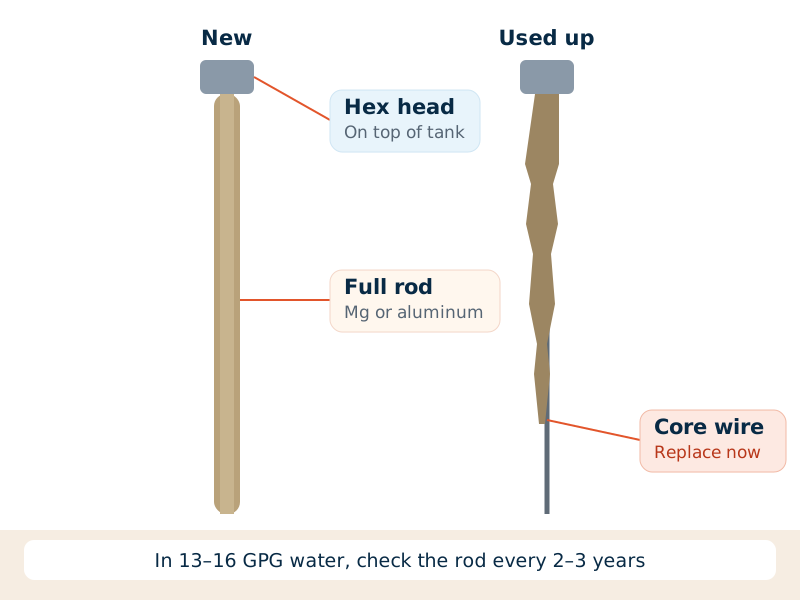
Anode rod replacement means removing the worn metal rod that hangs inside a tank water heater and installing a new one. The rod corrodes on purpose so the steel tank doesn't. Once it's eaten down to its core wire, the tank starts to rust. In Apache Junction's hard water, we recommend checking it every 2–3 years.
Every glass-lined steel tank has at least one anode rod. It screws into the top of the tank, usually under a hex head about the size of a large bolt. Some heaters have a second rod built into the hot-water outlet fitting, called a combination anode. You can't see the rod wearing out, which is why it's so often ignored until the tank leaks.
Why the Anode Matters So Much Here
Inside the tank, hot water slowly attacks any bare steel it can reach through tiny gaps in the glass lining. The anode rod is made of a metal that corrodes more easily than steel, so the water goes after the rod first. It's a sacrificial part. As long as there's rod left, the tank is protected.
Hard water speeds this up. Apache Junction tap water runs about 13–16 grains per gallon of hardness, more than double the US average of about 6. Mineral-heavy water and high temperatures make the rod work harder, and scale can coat parts of it so it wears unevenly. Our Apache Junction hard water page explains where that hardness comes from.
How often should the anode rod be checked in Apache Junction?
Our recommendation is every 2–3 years, starting when the heater is about 3 years old. That's more often than many tank labels suggest, but we see rods used up early in this water. Tanks in the East Valley often show trouble at 7–9 years, against 8–12 years nationally. A rod check is how you push back on that. Our Arizona water heater lifespan guide covers the rest.
When should the rod be replaced?
A common rule is to replace it when the steel core wire shows for 6 inches or more, or when the rod is worn to about half its original thickness. Heavy pitting, chunks missing, or a rod that's just a wire with lumps on it are all clear signs.
Magnesium, Aluminum or Powered: Which Rod?
There are three main choices. The right one depends on your water, any smell problems and how much clearance you have.
| Rod type | Good points | Things to know |
|---|---|---|
| Magnesium | Strong protection for the tank | Wears faster in hard water; most likely to cause rotten-egg smell |
| Aluminum (often with zinc) | Lasts longer in hard water; zinc blends help with smell | Slightly less active than magnesium; leaves more residue as it wears |
| Powered anode | Doesn't wear away; stops most smell problems | Needs a nearby outlet and must stay plugged in; costs more up front |
A powered anode uses a titanium rod and a small electric current from a plug-in power supply to protect the tank. Because nothing is used up, there's no rod to swap every few years. The catch is that if it gets unplugged, the tank isn't protected. That matters for snowbird homes where power may be off for months.
Will changing the rod type affect my tank's warranty?
It can. Some manufacturers address anode changes in their warranty terms, and the rules differ by brand. We won't guess on yours. Check the warranty paperwork or call the maker before switching rod types on a heater that's still covered. Replacing a rod with the same type is the safest choice on a newer tank.
Rotten-Egg Smell in Hot Water
If only your hot water smells like rotten eggs, the anode rod is usually part of the story. Sulfate-reducing bacteria that live harmlessly in some water react with a magnesium rod and give off hydrogen sulfide gas. That's the smell. It tends to be worse in tanks that sit unused, which is common in winter-only homes.
The usual fixes:
- Swap to an aluminum-zinc rod. The zinc helps block the reaction. This solves many cases.
- Install a powered anode. It doesn't feed the reaction at all, so it's the most reliable fix for stubborn smells.
- Flush and disinfect the tank at the same time to clear out the bacteria that are already there.
Never just pull the anode out and leave it out to stop a smell. The smell goes away, but the tank starts rusting right away.
Tip: If both hot and cold water smell, the anode isn't the cause. The issue is in the water supply or the well, and the rod swap won't help.
How We Replace an Anode Rod
- Find the rod. We check whether it's under a separate hex head, built into the hot outlet, or both.
- Turn off the heat and cold water, open a hot tap to relieve pressure, and drain a few gallons so water doesn't spill when the rod comes out.
- Break the hex head loose. Many are very tight after years of heat. We brace the tank so it doesn't twist on its connections.
- Pull and inspect the old rod. Its condition tells us a lot about the tank's health and how often to check it next time.
- Install the new rod with thread sealant rated for potable water. In tight spaces we use a flexible, segmented rod.
- Refill, check for leaks and restore heat. Flushing sediment while the tank is partly drained is often worth adding.
What if the hex head won't budge?
Seized anode heads are common on tanks that have never been serviced. We use the right socket and a breaker bar or impact tool, and we brace the tank. On some older heaters the head is so seized that forcing it risks damaging the tank or its connections. If that's the case, we'll tell you, and the better money may go toward a new heater instead.
What if there isn't enough room above the tank?
A standard rod is often around 40 inches long and needs about that much clear space above the tank to come out straight. Garages with low shelves, interior closets and mobile home closets often don't have it. A flexible, segmented rod bends as it goes in, so it fits under low ceilings. These are common on mobile home water heaters and in park model heaters, where the tank sits in a short closet.
What Affects the Cost
- The rod type. Magnesium and aluminum rods cost less than a powered anode.
- Access and clearance. Low ceilings and tight closets may call for a flexible rod and more time.
- How tight the old rod is. A seized head takes longer to remove safely.
- Combination anodes. A rod built into the hot outlet means disconnecting the hot line too.
- Add-ons. A flush, a new drain valve or a smell treatment at the same visit.
We explain the price before any work starts. An anode rod is a small fraction of the cost of a new tank, and Angi lists an Apache Junction average of about $1,136 just to install or replace a water heater.
When a New Rod Won't Help
An anode can only protect steel that's still sound. If the tank is already leaking, or the rod comes out as a bare wire on a 10-year-old heater with rusty water, a new rod is too late. Our repair or replace guide explains how we decide.
Rod checks pair well with a yearly water heater flush, since both fight the same hard-water damage. You'll find anode work alongside our other services on the water heater repair service page, and our water heater leak repair in Apache Junction page covers leaks. Call (480) 555-0147 any time.
Anode Rod Replacement FAQs
How do I know if my anode rod is bad without pulling it?
You can't know for sure without looking, but clues include rusty or brown hot water, a rotten-egg smell in the hot water only, and a tank that's over 5 years old with no record of a rod check. The only real test is pulling the rod and checking how much metal is left.
Do electric water heaters have anode rods?
Yes. Almost every glass-lined steel tank has one, gas or electric. On electric heaters it's usually under a hex head on top. Some models use a combination anode built into the hot outlet fitting instead of, or in addition to, a separate rod.
Does a water softener make the anode rod wear faster?
Softened water can wear a rod faster, because softened water conducts the reaction more readily. That doesn't mean a softener is bad for your heater. It means the rod should be checked on schedule, every 2–3 years in our view, so it doesn't run out unnoticed.
Can I replace an anode rod on a 10-year-old water heater?
You can, if the tank isn't leaking and the rod comes out without a fight. But on a tank that age, the rod is often long gone and some rust has already started. A new rod may add some time, but we'll be honest if the money is better spent on a new heater.
What is a combination anode?
It's an anode rod built onto the hot-water outlet nipple, so it screws in where the hot pipe connects. Some heaters have only this, others have it plus a separate rod. Replacing it means disconnecting the hot line, which adds a little time to the job.
Do tankless water heaters have anode rods?
No. Tankless heaters don't store water in a steel tank, so they don't use a sacrificial anode. Their hard-water care is descaling the heat exchanger, usually once a year in water like ours.