Why Is My Water Heater Leaking?
A leaking water heater usually has one of five causes: a loose or rusted pipe fitting on top, a dripping temperature and pressure (T&P) relief valve, a drain valve that won't seal, a leak at the gas control valve, or a tank that has rusted through. The first three are normally repairable. A rusted-through tank has to be replaced.
The fastest way to know which one you have is to find the first wet spot. Water runs down, so a puddle on the floor tells you very little on its own. A drip from a fitting on top can run down the side of the tank and look exactly like a bottom leak.
This page walks you through a simple top-to-bottom check. It's the same order we use when we arrive at a home in Apache Junction. If you'd rather not look yourself, call us at (480) 555-0147. We're open 24 hours, 7 days a week.
Safety first: if water is spraying, or you see water near an electrical outlet or panel, turn off the cold-water valve and the power before you look closer. If you smell gas, leave the house and call 911 and your gas company (Southwest Gas, or your propane supplier) from outside.
Before You Start: Stop the Water
You don't need to drain anything to find a leak. You just need to slow it down so you can see where it starts.
- Turn off the cold water to the heater. The valve is on the cold pipe above the tank. A lever handle goes crossways to the pipe. A round handle turns clockwise.
- Turn off the heat. Flip the breaker for an electric heater. Set the gas control knob to "Pilot" or "Off" on a gas heater.
- Dry everything. Wipe the tank, the pipes and the floor with a towel.
- Wait 10 to 30 minutes, then look again from the top down.
Our full step-by-step guide, including tankless units and mobile-home closets you reach from outside, is on the how to shut off a water heater page.
Where Is the Water Coming From? Check These 6 Spots
Work from the top of the heater to the floor. The highest wet spot you find is almost always your leak.
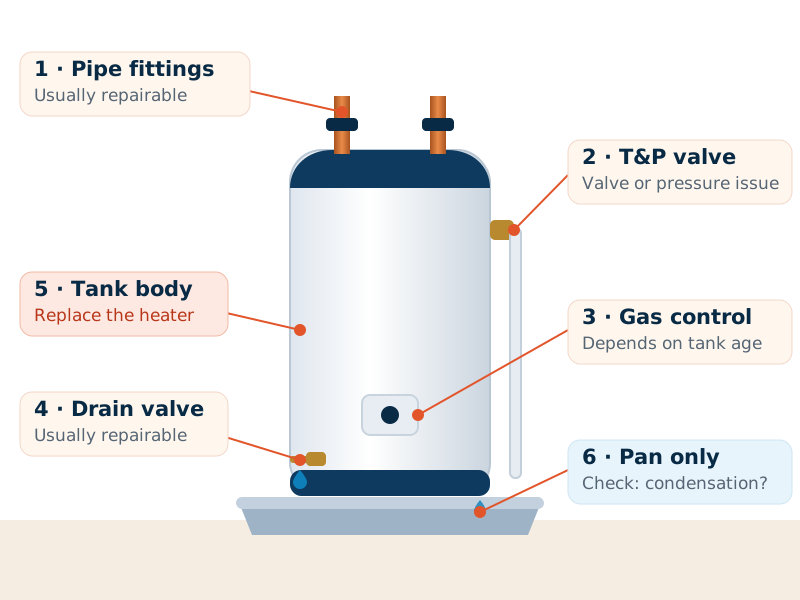
| Where you find water | Most likely cause | Usually |
|---|---|---|
| Pipes and fittings on top of the tank | Loose or corroded connection, worn flex connector, rusted tank nipple | Repair |
| T&P relief valve or the pipe running down the side | Worn valve, or pressure building with no working expansion tank | Repair |
| Gas control valve on the front | Water getting out where the valve threads into the tank | Depends on tank age |
| Drain valve near the bottom | Cracked plastic valve, worn washer, or sediment keeping it open | Repair |
| Bottom seam, under the jacket, or wet insulation behind the access panel | Inner tank has rusted through | Replace |
| Drain pan only, tank looks dry | Condensation on a gas unit, or a drip from something above | Often no repair |
What Each Leak Spot Means
Water on top of the tank
The cold inlet and hot outlet connect to short steel pipes called nipples. In Apache Junction's hard water, those nipples and the connectors on them corrode over time. You'll often see white or green crust, or a rusty ring, around the leak. Tightening sometimes helps for a while, but a corroded nipple or connector usually needs replacing. This is a repair, not a new heater, as long as the tank itself is dry.
Water dripping from the relief valve pipe
The T&P valve sits on the top or upper side of the tank, with a pipe running down toward the floor. Water from that pipe is the valve letting out pressure or heat. A slow, steady drip usually means a worn valve. Water that comes out now and then, often on hot afternoons, usually points to thermal expansion. Read more on our relief valve leaking page.
Water around the gas control valve
On gas heaters, the control valve threads into the front of the tank. Water around those threads can come from a failing seal or from corrosion in the tank wall behind it. On a young tank it can sometimes be fixed. On an older one, it's often the first sign the tank is wearing out.
Water dripping from the drain valve
The drain valve near the bottom is used to flush the tank. Many factory valves are plastic. With our hard water, sediment collects in the bottom of the tank and can stop the valve from closing fully. Replacing it with a brass valve is a common, inexpensive fix. See the drain valve leaking guide.
Water from the bottom seam or behind the access panel
If the tank is wet under the outer jacket, or the insulation behind the burner or element access panel is soaked, the steel tank inside has rusted through. A tank can't be patched safely. This one means replacement. Our tank leaking page explains why and what to do next.
Water in the pan, but the tank looks dry
Gas water heaters can "sweat" when cold water fills a warm tank, especially on cool winter mornings. That condensation drips onto the burner and into the pan (our condensation vs. leak guide shows how to tell them apart). It dries up once the tank is fully hot. A real leak keeps going. Also check for drips from anything above the heater, like a supply line or an air conditioner condensate line.
Is a Bottom Leak Always the Tank?
No. This is the most common mix-up we see. Water collects at the bottom no matter where it starts. A T&P valve pipe empties near the floor, a drain valve sits at the bottom, and a drip from a fitting runs down the tank wall. Only when those three are dry and the tank is still wet is it the tank. We cover this step by step on the water heater leaking from bottom page.
Tip: Tuck a dry paper towel under each fitting, the T&P pipe and the drain valve. Check them in 30 minutes. The wet towel points to the leak.
Why Water Heaters Leak Early in Apache Junction
Water heaters here wear out faster than in many parts of the country. A few local reasons:
Very hard water
Apache Junction tap water runs about 13–16 grains per gallon, more than double the US average. Sediment builds in the tank and wears out valves and anode rods faster. More on Apache Junction hard water.
Summer heat
July highs average about 105°F. Heaters in closed garages and outdoor closets sit in even hotter air, which is hard on relief valves, washers and flex connectors.
Monsoon season
From June 15 to September 30, storms bring power surges and outages that can damage electric elements and thermostats, and rain can reach outdoor units.
How homes are built
Almost half the homes in town are mobile or manufactured homes. Many heaters sit in tight closets over wood floors or on wood platforms in garages, so a slow leak does damage quickly.
When Should You Call Instead of Checking Yourself?
- Water is spraying or pouring, not dripping
- The leak is near an outlet, the breaker panel or the gas line
- You smell gas or see scorch marks near the burner
- The heater is in a closet you can't safely reach or see into
- The floor near the heater feels soft or spongy
- You've found the leak but aren't sure if it's repairable
Apache Junction Water Heater Pros handles leaks day and night from our office at 279 N Ironwood Dr, Apache Junction. We'll find the real source, explain whether it's a repair or a replacement, and go over the price before any work starts. You can also see everything we fix on our water heater repair in Apache Junction page, or go back to our water heater leak repair homepage.
Water Heater Leaking FAQs
Is a leaking water heater dangerous?
A slow drip isn't usually dangerous in the first few hours, but it can damage floors and walls quickly. The real risks are water near electrical outlets, a gas smell, or a relief valve that's been capped. Turn off the water and the power or gas, and call if you're unsure.
Should I turn off my water heater if it's leaking?
Yes. Turn off the cold-water valve on top of the tank, then switch off the breaker on an electric heater or set the gas knob to "Pilot" or "Off." That stops more water going in and keeps the heater from running with a low or empty tank.
How do I know if my water heater leak is serious?
It's serious if water comes from the tank body, the bottom seam, or the insulation behind the access panel, because that means the tank has rusted through. Leaks from fittings, the drain valve or the relief valve are usually fixable, though they still need attention soon.
Can a water heater leak from the top?
Yes. Leaks on top usually come from the cold inlet, the hot outlet, the tank nipples or the flex connectors. Hard water corrodes these connections over time. A top leak is normally a repair, as long as the tank itself is dry.
Why is there water under my water heater but no leak?
On gas heaters it's often condensation, especially on cool mornings when cold water fills a warm tank. Condensation dries once the tank is hot. Also check for drips from pipes or an AC line above the heater. If the water keeps coming back, it's a leak.
How long can I leave a leaking water heater?
Not long. A small valve drip can wait a day or two with the water off. A leaking tank should be replaced as soon as you can, because rusted tanks can fail suddenly and release a lot of water.