Can a Leaking Water Heater Tank Be Fixed?
No. Once the steel tank inside a water heater has rusted through, it can't be repaired safely. Sealants, epoxy, patches and welds don't hold under constant heat and pressure, and the rust you can see is only part of the damage inside. The only real fix for a leaking tank is replacing the water heater.
That's the honest answer, but it comes with an important "first." Many leaks that look like tank leaks aren't. Before you replace anything, make sure the water isn't coming from a fitting, the relief valve or the drain valve. Those are repairable, and they're more common than true tank failures.
How to Confirm It's Really the Tank
A tank leak is what's left after you've ruled out the parts that can be fixed. With the cold water and power or gas off, check these in order:
- Top connections. Dry the cold inlet, hot outlet and tank nipples. Check again in 20 minutes. Wet means a fitting leak, not the tank.
- Relief valve and its pipe. A wet valve or a damp pipe end points to the T&P valve.
- Drain valve. A wet spout or wet threads at the bottom point to the drain valve.
- Gas control valve (gas heaters). Look where it threads into the front of the tank.
- Behind the access panels. With the power or gas off, remove the burner cover or element covers. Wet, rusty or soggy insulation means the tank is leaking.
- The bottom seam and jacket. Rust streaks or weeping water along the base, with everything above dry, is a tank leak.
Not sure what you're looking at? Our water heater leak finder shows every spot with a diagram, and our leaking from bottom guide covers the three most common bottom leaks.
Why Do Water Heater Tanks Rust Through?
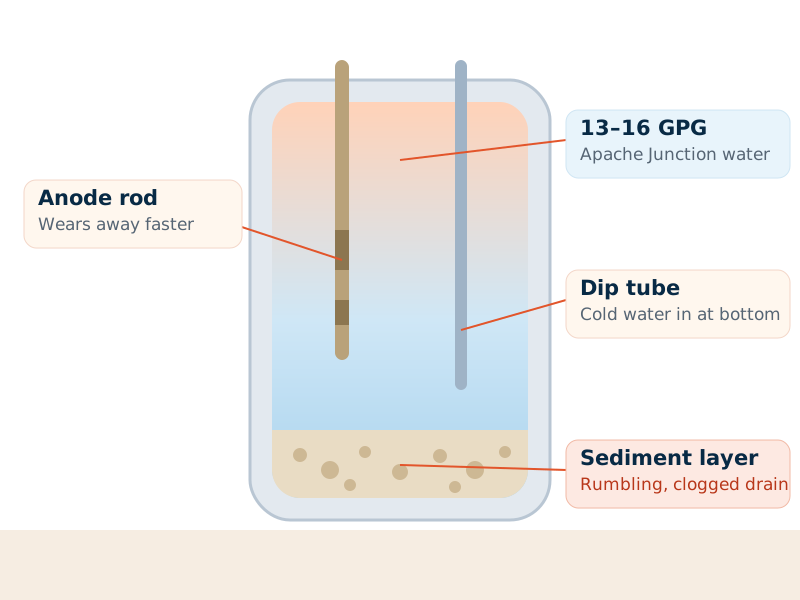
Every tank is a steel shell lined with glass. The lining isn't perfect, so the tank also has an anode rod, usually magnesium or aluminum, that corrodes first and protects the steel. When the anode is used up, the steel takes the corrosion instead.
Why do tanks fail sooner in Apache Junction?
Our tap water runs about 13–16 grains per gallon of hardness, more than double the national average of about 6. That has two effects. Calcium settles at the bottom as sediment, which traps heat and stresses the steel right where tanks usually fail. And hard water tends to use up anode rods faster. Nationally, tanks often last 8–12 years. In East Valley hard water, many start having trouble at 7–9 years. Our Apache Junction hard water page explains more.
Does heat make it worse?
It can. July highs average about 105°F here. A heater in a closed garage or an outdoor closet works in hotter surroundings for months, which is hard on the relief valve and connections even if it isn't the main reason a tank rusts.
Why Can't You Patch a Leaking Tank?
It's under pressure
A tank holds city water pressure plus heat. A patch on the outside can't hold back water pushing from the inside every time the heater runs.
The damage is bigger than the hole
The leak you see is where rust finally broke through. The steel around it, and often elsewhere in the tank, is thin too.
Heat breaks down sealants
Epoxies and leak sealers soften and crack with repeated heating and cooling. They might slow a drip for days, not years.
It can fail all at once
A weeping tank can split and release its whole volume, 40 or 50 gallons, onto your floor. That's the outcome to avoid.
My Tank Is Leaking. What Should I Do Now?
- Keep the water and heat off until the heater is replaced.
- Check the label. Find the brand, model, serial number, gallons and fuel type (gas or electric). Snap a photo.
- Check the warranty. If the heater is fairly new, the manufacturer's tank warranty may cover the tank. You'll need the serial number.
- Look for damage. Press on the floor near the heater, check the wall behind it, and photograph any wet areas before cleanup if you plan to call your insurance agent.
- Call us. We'll confirm the leak source, go over replacement options and price, and get your hot water back.
Will insurance pay for a leaking tank?
Usually not the heater itself. Standard homeowners policies don't pay to replace appliances that wear out. Many do cover sudden water damage to floors and walls, but not damage from a slow leak that went on for weeks. Call your agent to ask about your policy. If you have a home warranty, call them first, since they usually send their own contractor.
What Replacing a Leaking Tank Involves
A replacement isn't just swapping one tank for another. A proper job is also the time to fix whatever let the last leak do damage:
- Choosing the right size and fuel type for your home, including models approved for manufactured homes
- A drain pan with a drain line that carries water somewhere safe
- A full-size relief valve discharge pipe, never capped or reduced
- An expansion tank where your plumbing needs one
- A solid stand in place of a water-damaged wood platform
- Haul-away of the old tank
Phoenix-area homeowners pay about $1,224 on average for a standard tank replacement, with most jobs between $797 and $1,659. Details are on our water heater repair cost page, and the full process is on our water heater replacement in Apache Junction page. For any other leak, start at our water heater leak repair homepage.
Water Heater Tank Leaking FAQs
How long can a water heater leak before it bursts?
There's no safe way to predict it. Some tanks weep for weeks, others split within days. Once you've confirmed the tank itself is leaking, shut off the water and the power or gas and plan the replacement right away.
Can I use a water heater sealant or epoxy on the tank?
We don't recommend it. Heat and pressure break sealants down, and the steel around a rust hole is usually thin too. At best it slows a drip briefly. It doesn't make the tank safe.
What does wet insulation behind the access panel mean?
It almost always means the inner tank is leaking. Water from a tank leak soaks the insulation between the tank and the outer jacket and shows up behind the burner or element covers. Turn off the power or gas before you look.
Is a leaking tank covered by the manufacturer's warranty?
Sometimes. Many tanks carry a tank warranty for a set number of years from the date made or installed. Check the label or the manufacturer's site with your serial number (here's how to read it), and see new water heater leaking for young tanks. Labor and installation may not be included.
My water heater is only a few years old. Why is the tank leaking?
Hard water, high water pressure and a fast-wearing anode rod can shorten a tank's life. But on a young heater, double-check the fittings, drain valve and relief valve first. Those fail more often than the tank does.
Can I replace a leaking water heater myself?
Some homeowners do, but it involves water, gas or 240-volt power, venting and code items like the relief valve line and drain pan. Bigger changes, such as a larger unit, a fuel switch or a new location, also need a permit. If you're not comfortable with all of that, call a professional.